

The Consciousness Residency: A Recap
One month of consciousness research at Edge Esmeralda 2026, told through the residents, the experiments, and the questions that emerged.
July 15, 2026
Overview
In May, we introduced the Consciousness Residency with a diagnosis: consciousness research looks like a puzzle spilled across the floor. Insights scattered across science, philosophy, contemplative practice, and lived experience, with no picture clear enough to guide collective progress. Building on what Madison Richmond helped create at Edge City Patagonia, which proved that this environment is valuable for fields that don’t neatly fit into any existing box. Our bet was that a month of proximity, inside a living village, could do what conferences and siloed institutions cannot.

The month was a success and while the puzzle is nowhere near complete, let alone started, we felt we started finding pieces that fit together. Here is what one house produced between June 1 and 27, 2026:
- 4 experiments run on-site, with EEG, ultrasound, and phenomenology capture
- 4 papers drafted or in flight, three now in pre-publication or submitted
- 1 summit planned as a follow-up to co-author a piece on mindbody
- 4 tools and platforms shipped, several open-source
- 3 field-mapping frameworks in active development
- 25+ public talks, demos, salons, and experiments, with strong, sustained crowds in the middle of a packed festival
- 19 residents through the Inn at Edge Esmeralda, spanning neuroscience, philosophy, AI, contemplative practice, facilitation, and funding
Edge Esmeralda provided a container for research in the wild that’s more akin to startup building than academic: a clinical feasibility study taken from idea to data in three weeks. 82% of participants in an AI-guided insight protocol reporting a meaningful shift on a personal impasse. The first high-resolution ultrasound data of its kind on the vascular substrate of experience. A 400-person study on personalized reflection. An EEG-to-language model demoed live.These research studies were quick and iterative, vs long and thorough. The point wasn’t being thorough but instead getting a sense of where there is signal in this very fragmented and siloed field.
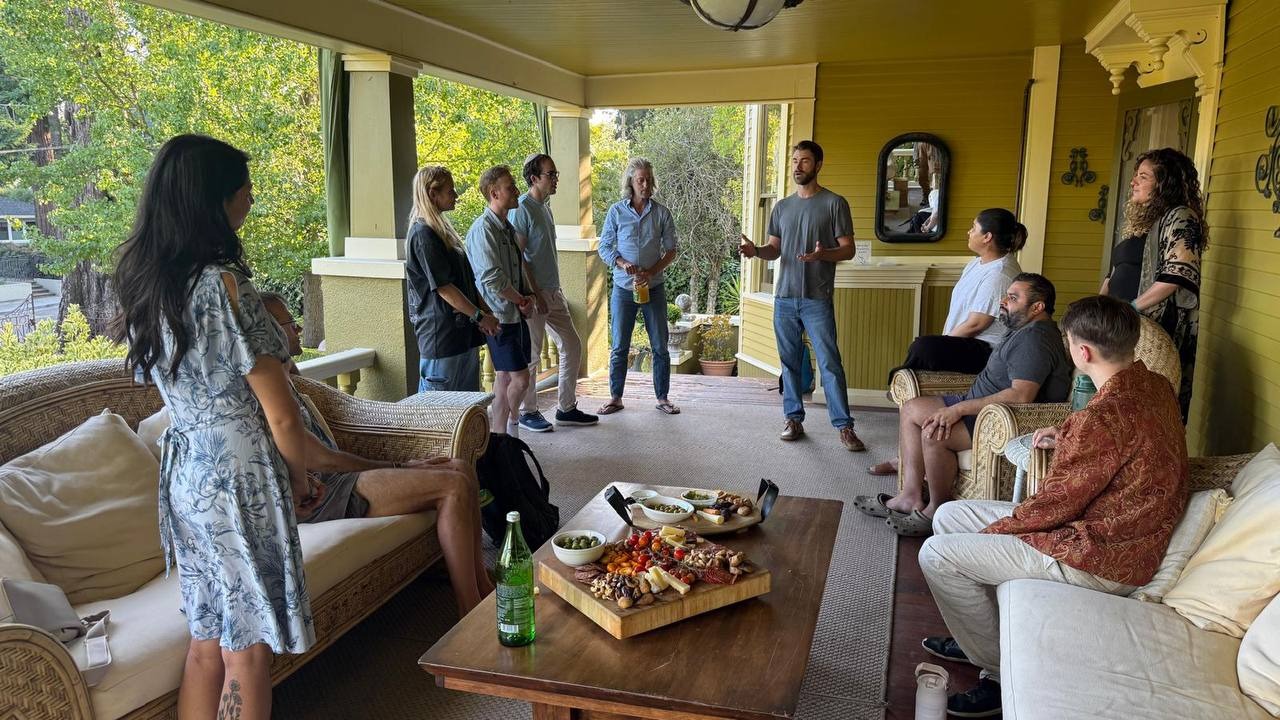
Beyond the experiments, the residents got the most value out of the environment and connections made in the residency and at Edge:
“ I can’t recall an environment more favorable to advancing existing projects and launching new ones. I was immersed in a radical blend of hungry students and developers, early- and mid-career researchers like myself, philosophers, elder gods, and funders — every piece needed to build a new research direction, plus a container safe enough to find allegiance around ambitious, unconventional ideas.” - Leo Christov Moore
"It's not only, 'I know this person, I can collaborate with them on this thing.' I know how they think, and I can import that into my own thinking. The ROI is absolutely there, and a lot of it is in the network." - Mike Johnson, founder of the Symmetry Institute
"Putting together a clinical trial and actually gathering data, doing a feasibility study. I don't think that would've been possible anywhere else but Edge…I'm a lot more likely to actually do consciousness research as a job after this month." - Peter Skov-Andersen, Meditation Research Program, MGH / Harvard
"There is a multitude of new collaborations, new organizations joining consortiums I'm running, and new meditation companies integrating my AI meditation tutoring tech." - Erik Enger Karlson
The residency was hosted by Edge City and could not have happened without the support of the Consciousness Foundation, the Mays Family Foundation, The Mares Family, and other supporters. We believe that helping humans human better is a fundamental topic to support in the next era. We’d love to continue these cohorts and they need sponsorship to happen. If you’re interested in supporting, reach us at dawn@edgecity.live or janine@edgecity.live.
The Month in Full
When we launched the residency, we wrote that the most important question right now may be the oldest one: how consciousness actually shows up in a human body. In tissue, breath, vasculature, and electrical activity. The science has been quietly maturing for a decade, but the people doing it rarely share a room for more than a conference weekend, mask their research under different fields and often work entirely alone.

We’ve seen in other Edge Cities how a shared home residency model, where people collaborate and learn from one another, can greatly inspire and accelerate progress. Given the fragmented and contrarian nature of this field, we wanted to experiment with bringing together a cohort of researchers, technologists, philosophers, contemplatives, and facilitators in one house for a month to convert scattered curiosity into a coherent field.
What we set out to do
- Make the field more coherent to a larger audience while accelerating meaningful collaboration across the fragmented field of consciousness research
- Use the Edge City environment: excited participants for experiments, an environment with a lot of activation energy for fast building and iteration, a curious multi-disciplinary audience to share ideas and demos
- Hold theory and practice together, so the people studying consciousness were also living alongside daily embodied practice.
The rhythm of the month
Week one opened with daily public Lunch & Learns at The Loft: consciousness across substrates, the hard problem, AI and EEG and the jhana states, and field research in practice. The first internal demo day, that same week, filled the room without being publicly announced.
From there the cadence had texture. A device demonstration with Nachum and Rachel Plonka of HeartMath. A biweekly Technodelic experiment for the month. Ultrasound readings to map tension in the body. A Joscha Bach machine-consciousness salon at The Loft that continued at the house until 4am. Non-consensus dinners with the Long Journey residency. Grift City, a working convention on self-awareness when building solutions for consciousness and awakening. A field building workshop for Consciousness. Weekly demo days ending in a final demo day for the village.

The house held more than researchers, and that was the design. Facilitators and contemplatives shaped the daily container as much as the experimentalists did, from morning pods and somatic vocabulary work with Raven of SleepAwake to serious sitting practice anchored by Winslow Strong in week one. Around the residency, the village's daily practices kept running: breathwork with Dr. Erica Matluck and Paul Kuhn, daily sound baths and meditation, yoga and ecstatic dance, sauna evenings, and shared meals from the Cookbook for Human Connection. Several of these fed directly into the research; the residency was studying the very states the village was practicing at noon and sweating out at night.
"I've always taken for granted how hard it would be to switch ontologies. Your whole life can be shattered. There is a necessary gentleness to this stuff." - Sam Brown
Residency highlights
Mike Johnson with Alex Rockhill & Max Shen - Vasocomputation ultrasound. The first on-site run of a high-resolution contrast ultrasound protocol, with four subjects, mapping vascular "latch" signatures in 3D. It is the first data of its kind and the first empirical test of Mike's vasocomputation framework. Analysis is pending. (Full detail in the appendix.)

Peter Skov-Andersen - Neural entropy hollow-mask. A clinical feasibility study taken from idea to data in three weeks: eight recruited, six usable datasets, with reduced alpha power and increased neural entropy both tracking subjective intensity. Peter also shipped Cluster Info, a public recruitment platform for cluster-headache sufferers, in week one.

Erik Enger Karlson & Leo Christov-Moore - Insight Generation Protocol. An AI-guided impasse interview (the i3T toolkit) where 82% of 17 participants reported a meaningful shift or new clarity. Now a federated consortium: the Center for Minds and the Institute for Meditation & Brainwave Research have joined.
Leo Christov-Moore - Technodelic & Euqualia. The first in-person, group replication attempt of Leo's 398-person online study on chills-augmented loving-kindness meditation, with around 17 participants collected. Alongside it, Euqualia: a HIPAA-compliant, user-controlled tool for capturing inner experience in retreats and research.
Angie Normandale - The Ontology Project & Periodic Table of Qualia. Two field-mapping frameworks built with Mike Johnson and Erik Enger Karlson: a Claude skill that maps consciousness theories as a navigable binary tree (alpha available), and a first pass at deriving classes of phenomenal property through mathematical transformations, demoed June 18. Angie also built a database of consciousness researchers and "a skill that detects woo when you're reading consciousness papers with Claude."
"Working in the field of consciousness is really weird and can be very isolating. This is the most time I've spent ever with other people researching consciousness." - Angie Normandale
Max Shen & Tanner Holman - 5-day pain-resolution course. A complete course built on-site, grounded in 19 recovery interviews, plus a two-hour vasocomputation and chronic-pain podcast with Mike Johnson, a budding chronic-pain organization, and advisory work with Somnistic, Mayo, and TruMed.

"There is just more of a sense that I'm not on my own, thinking about this problem." - Max Shen
Hikari Sorensen & Franz Hildebrandt-Harangozó - Computational Minimum Phenomenal Experience. A paper formalizing Metzinger's MPE, with an epistemic-functionalist argument that machine consciousness is in principle possible. Aimed at philosophers of mind.
Albert Brox - EEG-to-semantic-embedding model. A model that predicts where a concept sits in embedding space directly from EEG, above baseline, demoed live during a three-day visit. Open-source EEG hardware is in the works, targeting under $1,000 per headset.
Sam Brown - Quantum-reflection matchmaking. A 400-person study found reflections felt 10 to 20% more resonant when personalized, with belief the strongest predictor. The reflection-mirror app is live; the matchmaking layer is in development.
And behind these: Adam Safron left with three papers in flight (one targeting AGI-2026) and continues with the cohort remotely. Theo Sechopoulos ran an exploratory thread linking valence in active inference to the Buddhist "last fetter," reviewing roughly 50 models. Wyatt Rodgers, who led the residency on the ground, advanced his open-label placebo and chronic-illness work throughout.
What we learned
1. The core value was relational density. Every resident located the residency's primary value in the people. That value was legitimacy, companionship, intellectual compression, and future access in a field where serious peers are rare. In our structured coding of resident interviews, relational density was the strongest theme in the entire corpus, and it carried almost no friction.
"Where, other than conferences can you get the density of time with people that think consciousness is the most important thing to work on? At conferences you'd get it for a few days. Here you're a whole month of living with people." - Peter Skov-Andersen
2. It ended the isolation of the work. Consciousness research can be lonely. For many residents, this was the first time that lifted. Belonging and field identity coded as a benefit for every single resident interviewed. The month changed how people saw their own place in the field.
3. It moved careers. Residents pointed less to outputs than to a shift in where they stood: peers who took the work seriously, and the knowledge that the field is real. Several described lasting changes to what they plan to work on next.
4. The diversity in the room was a gift, and it needs hosting. The house held physicalists, idealists, computationalists, contemplatives, and empiricists, a span you almost never get under one roof. Residents prized the exposure and also felt the risk of talking past one another. Next year we'll stage the big debates deliberately rather than hope they resolve over dinner.
5. Proximity protects itself. Purpose needs a contract. The field is still finding its shape. Consciousness research today is scattered across science, philosophy, contemplative practice, and industry, and a month together showed just how early we still are. Residents came in pursuing different aims: deep individual work, field-building conversations, hands-on experiments, funder outcomes, personal exploration. All of it was valuable, and together it made for a residency without one single answer to what it was for. Daily check-ins, built for quick, tangible progress, suited some of that work well and sat awkwardly with research that takes months to show results.
Why it matters
The residency format showed that a high-context, high-trust month moves consciousness science from a scattered set of curious people toward a coherent field faster than conferences can. New pairings formed every week. Papers, tools, experiments, and collaborations now exist that simply would not have otherwise, and several of them, from the i3T consortium to the chronic-pain organization to the open-source EEG hardware, are already reaching well past Healdsburg. While the field is still small, the shared sense making helps build a stronger foundation for new people to join.
In May we said this field is heavily underfunded for how high-impact the results could be, and that we want to see it go from tens of millions in funding to billions. One month in one house is a small data point. It is also exactly the kind of data point the field has been missing.
Thank you
Deep gratitude to the Consciousness Foundation and Winslow Strong, to Janine Leger and Justin at Edge City, to Wyatt Rodgers and Madison Richmond for holding the container, to Kati Devaney for being a constant scientific presence, and to the Mays Family for their contributions. And to the residents, who brought rigor, openness, and a willingness to sit with one of the hardest questions there is.
This is just the beginning. Follow along @JoinEdgeCity for more fellowships and residencies.
With love, The Edge City team ☀️
Appendix: The Experiments in Detail
Most consciousness research happens in one of two places: the retreat center or the lab. Retreat centers offer depth but pull the subject out of life. Labs offer rigor but impose artificial conditions. Both produce findings that don't travel well. Edge Esmeralda is neither: a real place where people live, work, collaborate, and argue, with consciousness practices running alongside all of it. The findings are messier to produce. They're also more likely to hold. Here is each experiment as designed and where it landed.
1. Sensoria: Chills-Augmented Meditation in the Wild Lead: Leonardo Christov-Moore | Tues/Thurs 3-4pm, Wellness Space
Hypothesis: A chills-augmented loving kindness meditation (LKM) delivered in a live group setting will produce comparable or enhanced self-transcendence, emotional breakthrough, and psychological insight relative to the original online study (n=398), with group co-presence potentially amplifying chills occurrence and downstream effects.
Background: In a February 2026 paper published in Frontiers in Psychology, Leo and colleagues demonstrated that pairing a validated LKM with chills-inducing music significantly increased ego dissolution, connectedness, moral elevation, and psychological insight compared to meditation alone. That study was conducted remotely, with individuals in isolated home environments. Edge City is the first attempt to replicate it in-person and in a group.
Approach: Participants undergo the validated chills-augmented LKM protocol in a shared group session. Pre/post measures include ego dissolution, connectedness (self/others/world), mood, emotional breakthrough, and psychological insight. Results will be compared directly to published online benchmarks.
Sample size: 17 collected to date (pilot: 3, first collection: 14). Three or more additional sessions planned group ; target n of 30+.
Output: White paper comparing in-person group findings to online individual baseline; potential journal submission on the group resonance effect.
2. Entropic Unmasking: Neural Entropy and Perceptual Priors Lead: Peter Skov-Andersen | Mon-Fri 3-5pm
Hypothesis: Higher neural entropy during an altered state correlates with a breakdown of perceptual priors, such that participants become more likely to perceive the hollow mask as actually hollow (i.e., to not experience the illusion).
Approach: This is a within-subject feasibility/pilot study. A wireless 8-electrode EEG (Unicorn BCI Core-8) records continuously for offline storage and real-time neural entropy estimation (permutation entropy). Each participant completes two conditions in a fixed order: sober first, then altered, with an identical task structure so that entropy and perceptual measures can be compared within-subject.
The altered state is induced by inhaling a compound believed to increase neural entropy. The hollow mask illusion serves as a proxy for top-down perceptual priors: under normal conditions, strong face priors force a concave mask to be seen as a convex (normal) face, so a reduction in prior precision should make veridical (hollow) perception more frequent.
In each condition, EEG is recorded during (1) a resting-state baseline (eyes closed) and (2) hollow-mask viewing. Because the altered state's peak subsides shortly after ~4 minutes, the hollow mask is presented during the post-peak window for 60 seconds while the mask rotates, and participants report how many times they perceive it as hollow, with each presentation covering one full rotation. We then relate within-subject changes in neural entropy (altered vs. sober) to changes in the rate of hollow perception. Qualitative interviews are further conducted to inform the safety and feasibility of the study design.
Sample size: 10
Output: A pilot dataset on the relationship between neural entropy and perceptual priors, contributing to predictive-processing accounts of altered states and consciousness. A first pass at whether the inhaled substance actually enables people to perceive the mask as hollow. Qualitative interviews on participants' experience of viewing illusions while under the influence, used to refine the design and assess safety and feasibility for future studies.
Limitations: As a feasibility pilot, this study has several constraints that bound interpretation rather than invalidate it. The fixed order (sober always first) means practice and habituation effects are confounded with condition; counterbalancing was not feasible given the substance's pharmacokinetics and the pilot scope. Baseline duration differs between conditions (5 min sober vs. 4 min altered) to accommodate the drug time-course; permutation entropy is relatively robust to epoch length, but the asymmetry is noted. The small sample (n = 10) limits statistical power and generalizability, so results are intended as effect-size and feasibility estimates to inform a larger study rather than confirmatory tests. The 8-electrode montage offers limited spatial coverage, and the hollow-percept measure (count per rotation) is a coarse readout of a continuous bistable process. Finally, the absence of a placebo/active control means expectancy effects cannot be separated from pharmacological ones.

3. Sound as a Consciousness Modulator Lead: Jess | Tues/Thurs 8-9pm
Primary hypothesis: Participants who undergo a 30-minute sound bath will show a significant increase in theta and alpha band power relative to baseline and a quiet-rest control, indicating a shift toward deeper relaxation, internal attention, and meditative absorption.
Secondary hypothesis: Sound bath participants will show decreased high-beta activity, suggesting reduced cognitive tension, rumination, and sympathetic arousal.
Approach: Live sound bath sessions using various instruments. Biometric and EEG-proxy data collected via Polar devices and Muse headsets, pre and post. Quiet-rest condition used as control for comparison.
Sample size: 20.
Output: Dataset on sound bath's measurable effects on brain states; white paper positioning sound as a low-barrier, non-pharmacological tool for inducing meditative states.
4. Impasse to Insight: Decision-Making and Contemplative Protocols Leads: Erik & Leo
Hypothesis: Contemplative and altered-state protocols will generate genuine, durable insight at rates above base rates for ordinary problem-solving, with non-canonical resolution pathways (where the type of resolution doesn't match the type of stuckness) indicating transformation mechanisms specific to non-ordinary states.
Background: Most research on decision-making and insight studies people in neutral conditions. This experiment uses the IIIT (Impasse, Insight & Integration Toolkit) to track 20 distinct types of psychological stuckness before a protocol, then codes what kind of resolution emerges at 24-48 hours, 2 weeks, and 4 weeks out. The key question is not just whether insight happens, but what kind of insight, from what kind of stuck, through what kind of state.
Approach: LLM-administered structured interviews at four timepoints (T0 intake, T1 post-protocol, T2 two weeks, T3 four weeks). Transcripts are coded by independent raters using the IIIT typology. Inter-rater reliability is computed across the cohort. Genuine insight is distinguished from affective insight (felt real but didn't hold) and false insight (retrospectively wrong).
Sample size: Target 20-30 participants across protocol types.
Output: Cohort-level dataset on impasse types, resolution rates, and depth-normalized effect sizes in naturalistic contemplative settings; potentially publishable contribution to the psychology of insight and the mechanisms of altered-state-assisted problem-solving.
5. Vasocomputation: The Vascular Imprint of Stress and Trauma Leads: Michael Johnson & Alex Rockhill | Calderwood Inn


Hypothesis: Blood vessels don't just carry blood. Through a mechanism unique to vascular smooth muscle, they maintain chronic tension that effectively "locks" patterns shaping how we think, feel, and process experience. A somatic intervention (TRE) will produce measurable shifts in microvascular tension, providing the first direct physical evidence linking a somatic practice to changes in the vascular substrate of conscious experience.
Background: Michael Johnson (founder of the Symmetry Institute, author of Principia Qualia) has developed vasocomputation as a framework connecting contemplative phenomenology, active inference, trauma, and embodied cognition through physical mechanisms in the vascular system. Alex Rockhill brings technical expertise in ultrasound and electrophysiology, with prior work across the Massimini and Tononi groups on Integrated Information Theory and Forest Neurotech on functional ultrasound imaging.
Approach: Participants undergo super-resolution ultrasound imaging of microvascular tension before and after a TRE (tension and trauma releasing exercises) session. Pre/post measurements are compared for detectable shifts in vascular tension patterns.
Sample size: TBD (small cohort; spots limited by imaging equipment and session time).
Output: If the signal is there, this would be the first published evidence of a somatic practice producing measurable changes in the vascular substrate of conscious experience — a significant contribution to both trauma research and theories of embodied consciousness.
6. Sound as a consciousness modulator
Lead: Jess · designed during the residency
Hypothesis: A 30-minute sound bath will increase theta and alpha band power relative to baseline and a quiet-rest control, indicating a shift toward relaxation and meditative absorption, with decreased high-beta activity as a secondary marker of reduced rumination.
Approach: Live sound bath sessions with biometric and EEG-proxy data via Polar devices and Muse headsets, pre and post, against a quiet-rest control. Target n of 20.
Outcome: Protocol designed and sessions hosted within the village's daily sound bath program. [Confirm final data collection status before publishing; this study is not counted in the four on-site experiments above.]
Papers, tools, and frameworks at a glance
Papers: Computational Minimum Phenomenal Experience (Hikari Sorensen & Franz Hildebrandt-Harangozó, targeting philosophers of mind); three papers on selfhood, standing and traveling waves, and self-organizing harmonic modes (Adam Safron, one targeting AGI-2026); valence in active inference and the Buddhist "last fetter" (Theo Sechopoulos, exploratory scoping across ~50 models).
Tools: EEG-to-semantic-embedding model plus open-source EEG hardware under $1,000 per headset (Albert Brox); Euqualia phenomenology capture (Leo Christov-Moore); Cluster Info recruitment platform (Peter Skov-Andersen); the 5-day pain-resolution course grounded in 19 recovery interviews (Max Shen & Tanner Holman).
Frameworks: The Ontology Project, an "It From Bit" Claude skill mapping consciousness theories as a navigable binary tree, alpha available (Angie Normandale, Mike Johnson, Erik Enger Karlson); the Periodic Table of Qualia, demoed June 18 (Angie Normandale); vasocomputation theory, now with its first empirical test (Mike Johnson).
Status reflects the June 25 final demo day, where eight residents presented the arc of their month.