

Cultural Fingerprints in a Networked World
Rhea's reflections from the Edge City Patagonia Fellowship on building technology for diaspora, culture, and belonging.
December 18, 2025
This is a guest post by Rhea Kapur, shared here with permission. The views are Rhea's own and do not necessarily reflect the views of Edge City. Read more Edge City Patagonia Fellowship reflections from Brian, Akshaya, Rucha, and Maxwell.
---
I joined the Edge City Patagonia Fellowship to build, to observe, to lay out the groundwork for a new technology I have long wanted to make—all while immersed in an entirely different part of the world. I am creating a new digital public space: a city-specific discovery system and social network to help people connect over language and shared cultural identity. Essentially, I am finding and indexing events, physical spaces, brands, and people in major cities that directly associate with a culture or ethnic group and its connected language(s): the diaspora.
Diaspora communities exist across the world (maybe one can even think of them as “network states”), but I believe they have not been effectively networked. In today’s increasingly global, transnational world, there is a great desire and struggle to return to one’s roots, especially after being uprooted in some way (e.g. moving across the world for work, school, or other opportunities). What if diasporas across the world could communicate with and locate each other easily, whenever they were in a new, unfamiliar place? What if they could support each other from wherever they were? Imagine mutual aid for impacted cultural businesses with reach to the relevant cultural communities across the world. Imagine being able to easily find and purchase artwork made by people who live near you, identify with your ethnic background, and speak your language. Imagine being in an interracial relationship and wanting to learn more about your partner’s culture, language, and heritage to love them better, and knowing exactly where to go near you to begin that process. I am creating a world where this is possible.
At Edge, I built a system that constructs a comprehensive knowledge graph for cultural locations and events in different cities around the world. As a starting toy project, I created an intelligent scraping workflow that tracks gallery listings in NYC and classifies them by artist background and exhibit relevance to a certain culture. I then expanded to extracting social media content, which is where many niche cultural events and locations have their digital presence. I experimented with many different methods to refine my scraping workflow, finding that a combination of embeddings search, AI web search, and finetuning or training custom models on my own cultural events datasets worked best.
I’m grateful to have had the support and companionship of my Fellows cohort while in this process of technical experimentation. Brian Kelleher sat down with me for many hours over the course of the fellowship to review my codebase and optimize my AI workflow and approach; I am so thankful for his help. Akshaya Dinesh and I compared notes on the SF tech scene over daily French vanilla lattes at Forastera Cafe. Rucha Benare and I shared many late night conversations in our cabana about the role of the scientific processes in our technical and artistic practices.
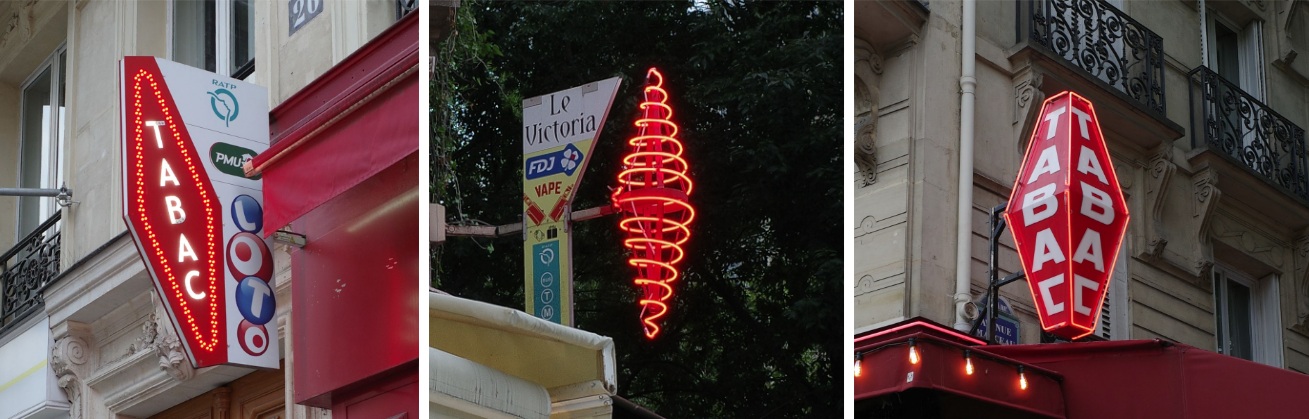
In the time leading up to Edge, I had been mulling over a concept which I call cultural fingerprinting: how repeated local “stencils” come to form, through their patterns and their variations, the visual aesthetic and culture unique to a place. I first thought about this in context of the “tabac” signs which can be found outside each tobacco shop in Paris. They all share the same general red diamond shape but can bear their own artistic variations: some are neon spirals with no words at all while others just have letters. To me, they seem to be a “cultural fingerprint” of Paris: something that takes hold in its urban environment, something that is deeply connected to French smoking culture, and something that does not quite appear in the same way in other parts of the world. For the last several months, I have been asking myself: what other cultural fingerprints exist across the world? What qualifies as a cultural fingerprint, even? How does each potential fingerprint connect with the sociopolitical context of the location in which it appears?
Walking around the lakefront area in San Martín de los Andes, I noticed a street sign covered in stickers. I looked to my left and saw another sign covered in stickers. Then another, then another.
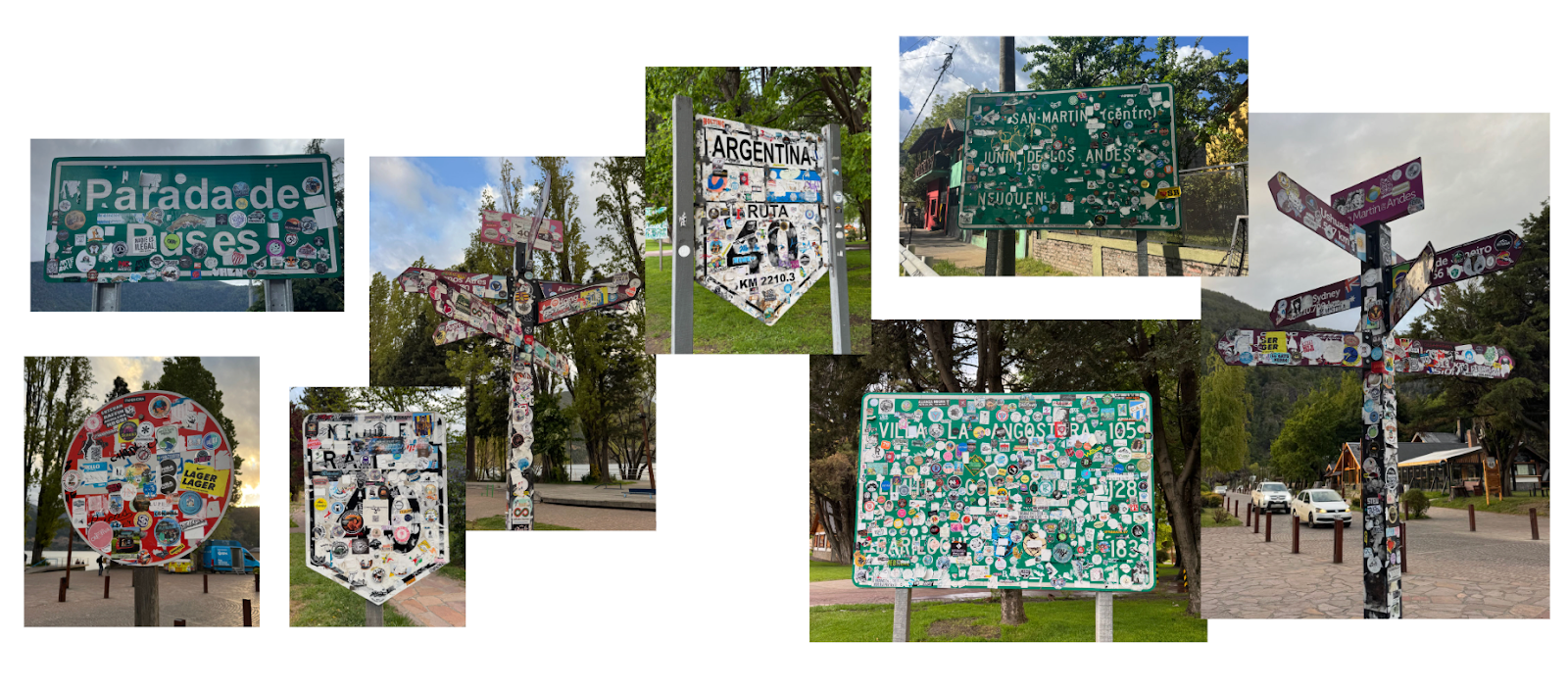
Who put the first sticker on the first sign in San Martín? When did others start doing the same? What caused the pattern to take hold? On one of the last days of the fellowship, I wandered into a sticker shop in town and finally found answers.
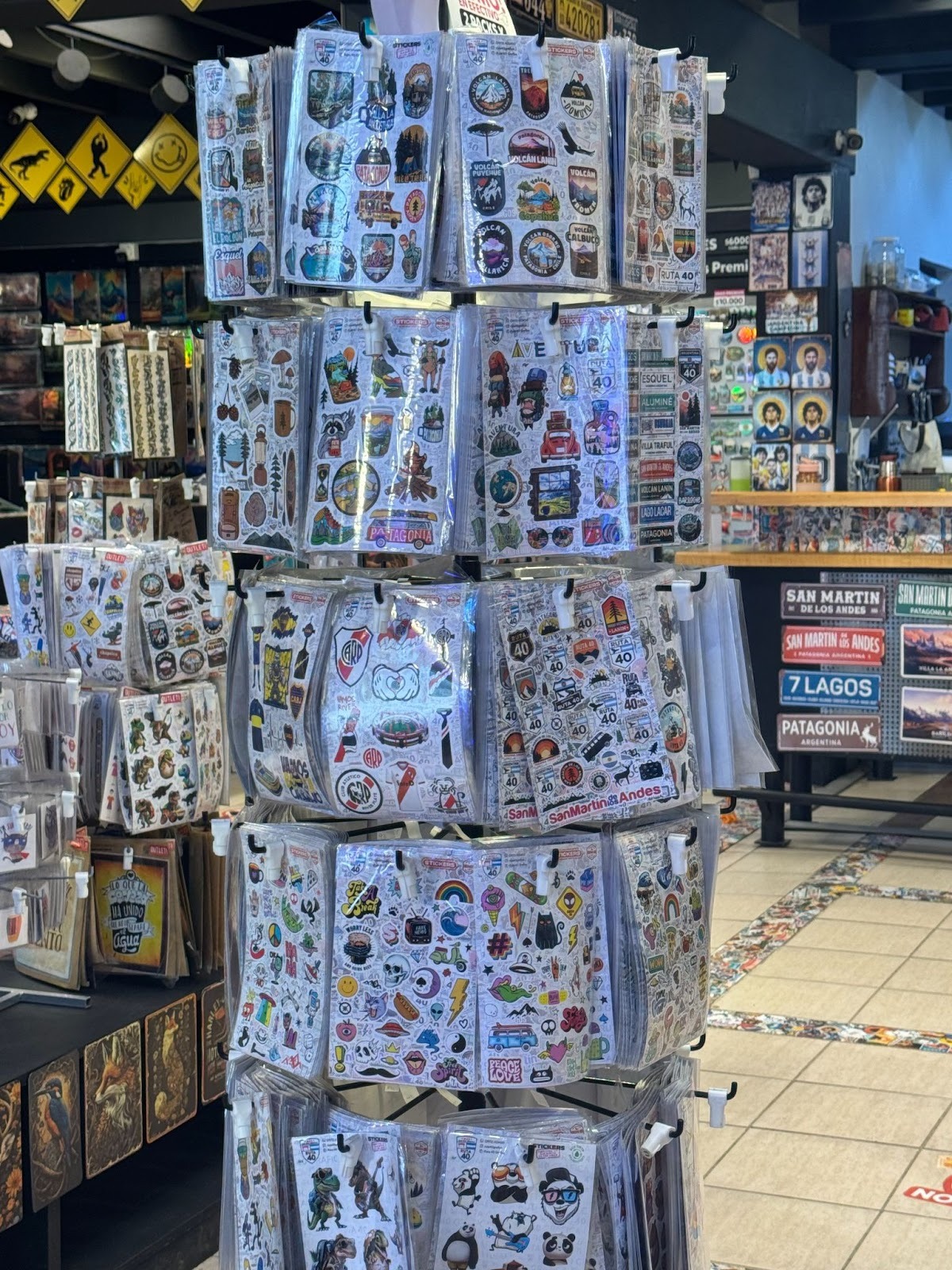
The lady working at the register—who has lived in San Martín all her life—told me that she started seeing these stickers a few years ago. “It seemed like one day they were all just there,” she told me. According to her, this “cultural fingerprint” is largely driven by Argentinian visitors (some of whom even bring their own stickers) and extends to signs around the nearby areas. I even saw one near the Chilean border on a weekend trip!
I am actively investigating the connections between cultural fingerprinting and my technical work in networking diaspora communities across the world. Both types of work to me begin with a process of deep observation. I believe that the patterns in the language of cultural events and in the signs and symbols of the world’s major cities are really not all that distinct.
More broadly, I am defining the space between language, culture, urban exploration, and software. I’m grateful to Edge City for believing in my work and giving me a space to trace all of these intersections, all in the lovely, supportive context of the Fellows Cohort.