

Recap: The Edge City Fellowship, Patagonia 2025
From mathematical frontiers to inclusive robotics: What happens when five high-agency builders live and work together in the Andes.
January 22, 2026
Summary
This year at Edge City Patagonia, we welcomed our second 2025 Edge City Fellowship cohort: five young, high-agency builders whose work sits at the intersection of science, technology, and culture.
For four weeks, they lived in our pop-up village in San Martín de los Andes, exploring projects that ranged from muscle-on-chip technologies and AI-driven mathematical reasoning to inclusive robotics, digital cultural networks, and consumer health innovation.
The Fellowship is designed to test a core hypothesis of Edge City: that innovation doesn’t happen in isolation. It happens in the friction and collaboration of living systems; where a mathematician can debug a scraper for a cultural researcher, and a bio-artist can find inspiration in a robotics demo.
Here is a look at what was built, how the cohort evolved, and the lessons we learned along the way.
The Experiment: Structure & Serendipity
The core idea of the Edge City Fellowship is simple. We take a group of high-agency builders and place them in the center of a thriving pop-up village teeming with technologists, scientists, artists, and innovators. We’re grateful for the support of Long Journey Ventures on this program.
This immersion is the "special sauce." It is a self-directed environment where a breakfast conversation with a quantum physicist can reshape an art project. A hike with a biohacker might spark a new product feature. The fellows were embedded in a living ecosystem of hundreds of curious minds, free to navigate the chaos and opportunity on their own terms.
To ground this high-energy experience, we established a rhythm anchored by nightly debriefs. These sessions started as 30-minute check-ins but often evolved into 90-minute deep dives into progress, frustrations, and life. They became the heartbeat of the cohort. This structure fostered a culture where wellness activities like finding healthy food or adjusting to the altitude were treated with the same importance as shipping code.
From the start, this group was exceptionally cohesive. Beyond co-working, they cooked together, traveled to Chile together, and supported one another through the highs and lows of the creative process.
As Fellow Rucha Benare described it, the group discovered "Manija"—an Argentine slang term for a turbo-charged flow state. "A door handle, like a turbo, once you have it set off, you can’t be stopped."
What Was Built
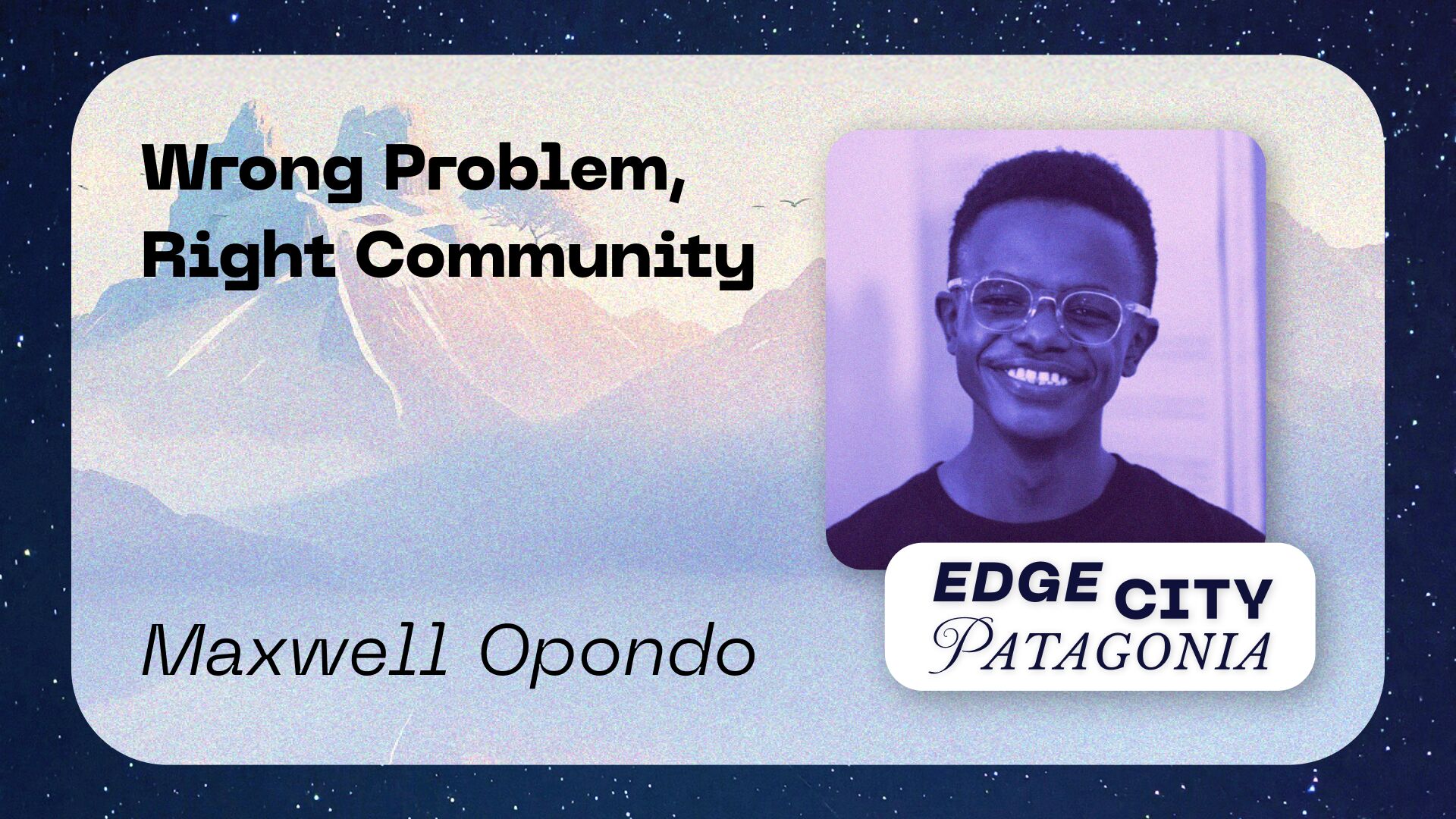
Maxwell Opondo — The Pivot to Impact
Inclusive Robotics & Accessibility Technology
Maxwell came to Patagonia to train a sign language model for the Deaf community. But after arriving and listening to locals, he realized he was solving the wrong problem. The community didn't just need translation; they desperately needed hearing aid calibration and diagnostics.
In a massive pivot, Maxwell developed SeñasConecta, a system for live transcription and automated hearing-aid calibration. He tested it with 25+ participants, achieving measurable improvements in speech recognition. He’s planning a follow-up trip from Kenya back to Patagonia to keep assisting the community there, making a massive impact for the locals, who otherwise would not be able to use their hearing devices.
From Maxwell: “The moment that grounded everything for me came after a demo. A local mother approached me, very quietly, and said, ‘If this tool works, my child will go to school every day again.’ That sentence hit harder than any keynote... It dissolved all the noise.”
What’s next: Maxwell is launching pilot programs in Bariloche and Neuquén and formalizing partnerships with local accessibility offices.
Read Maxwell’s recap essay here →
Connect with Maxwell on Linkedin and X.
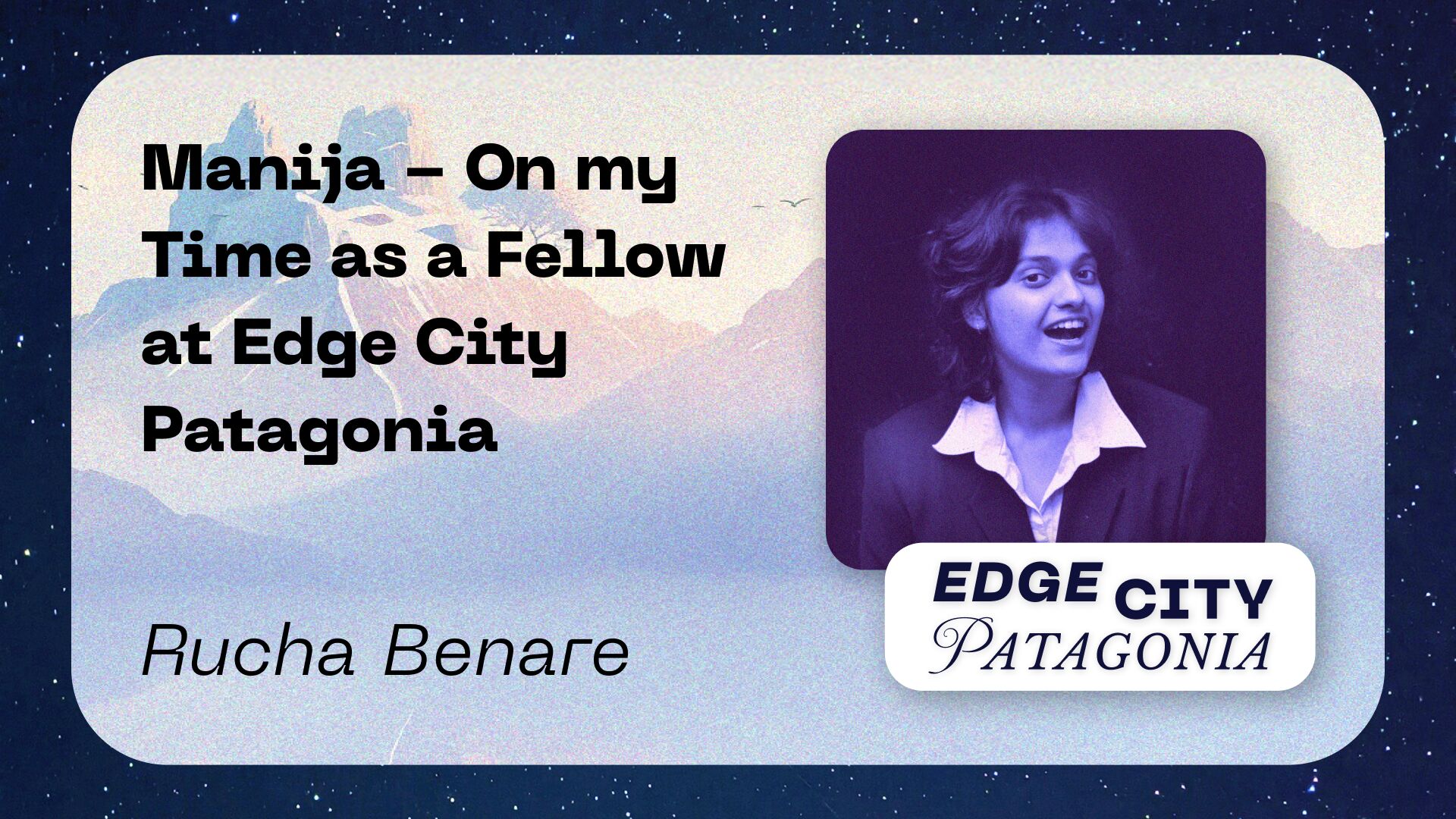
Rucha Benare — Biomechanics & The Art of "Manija"
Mechanobiology, Art, and Public Engagement
Rucha’s work bridges the gap between the microscopic and the artistic. During the fellowship, she engaged the local community to create participatory experiments blending biomechanics and poetry. This culminated in a pop-up exhibition featuring nine biomechanical artwork prototypes, co-created with other residents.
Rucha’s journey was a testament to the power of community support; turning a complex logistical challenge into a standing-room-only exhibition in just 72 hours.
From Rucha: “It made me think of how much more we need such islands of work, play, community as training grounds... to prototype a better future. It made me think of the people that are yet to join this yet. Who could also be architects of a better future.”
What’s next: Rucha is integrating these insights into her PhD research at the Royal College of Surgeons in Ireland and her art collective, Muse Ex Machina.
Read Rucha’s recap essay here →
Connect with Rucha via Linkedin.
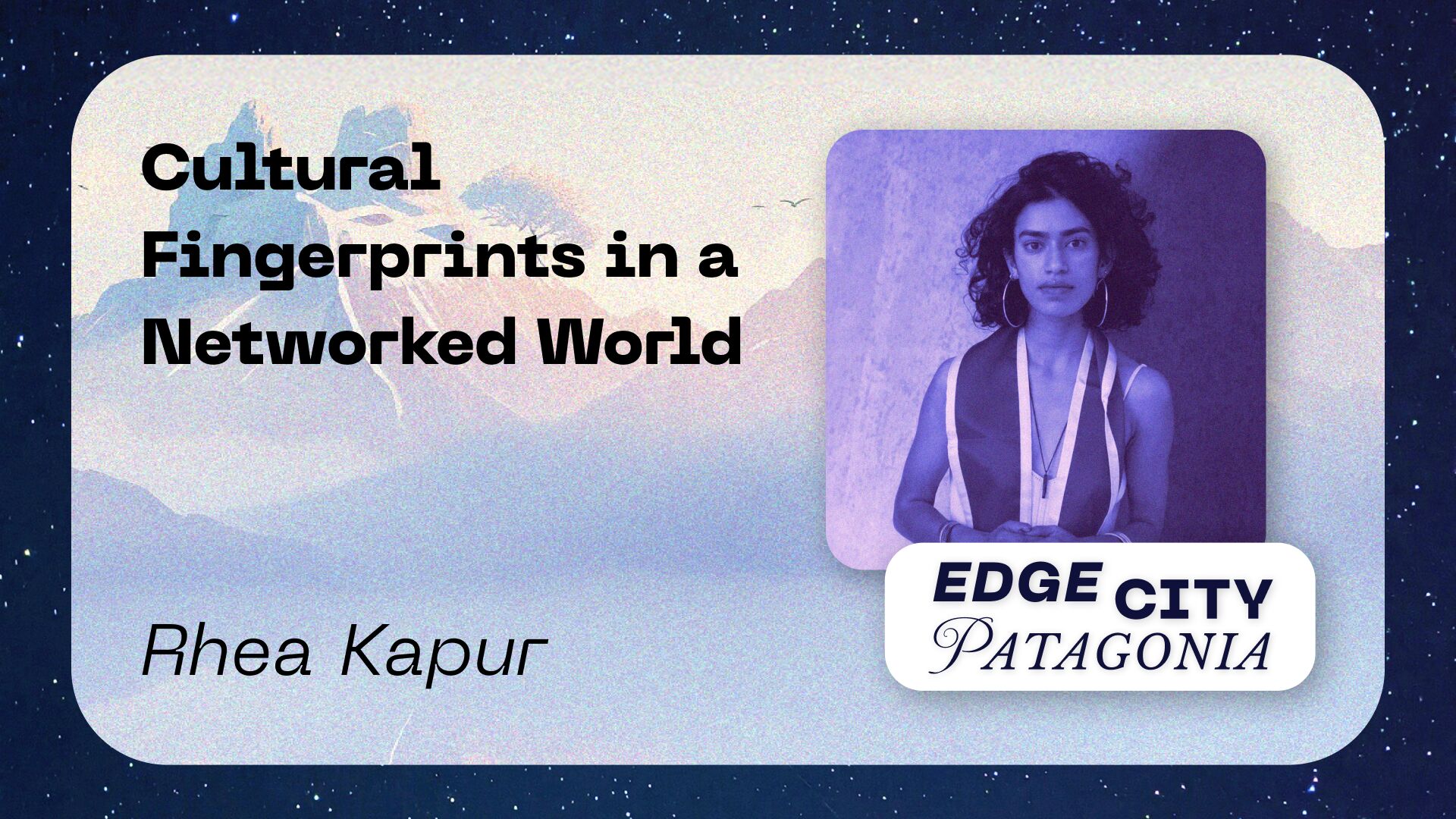
Rhea Kapur — Mapping Cultural Fingerprints
Cultural Computation & Social Systems
Rhea arrived to build a hyperlocal discovery platform for diaspora communities. At Edge, she moved from abstract concepts to a functioning prototype of Cultural Fingerprints, a system that maps cultural hotspots (galleries, events, community hubs) to help people find belonging in new cities.
She built an AI-assisted scraping pipeline to curate data from New York City galleries and identified "cultural fingerprints"—the unique visual and social stencils that define a place.
From Rhea: “I am creating a new digital public space... Imagine being able to easily find and purchase artwork made by people who live near you, identify with your ethnic background, and speak your language. I am creating a world where this is possible.”
What’s next: Rhea is relocating to New York City to launch the beta version of the platform and continue her work on data ethics for community discovery.
Read Rhea’s recap essay here →
Connect with Rhea on Linkedin and X.

Akshaya Dinesh — Building with Intention
Consumer Tech & Women’s Health
Akshaya came to Edge City recovering from burnout and looking to revitalize her app for women with PCOS (Polycystic Ovary Syndrome). The residency became a turning point—not just for her product, but for her relationship with work.
She grew her subscriber base, released a major update with a new symptom tracker, and began developing a nutrition-focused "recipes" feature. But more importantly, she found a sustainable rhythm, supported by the women’s health community at the village.
From Akshaya: “The most meaningful part of Edge City Patagonia was the community... They supported me, shared their own health journeys, and taught me about everything from seed cycling to cooking for hormone balance... These experiences broadened my perspective — not just on how my app could grow, but also on how I could care for myself with more intention.”
What’s next: Akshaya is building the MVP for her recipes feature and expanding her beta tester group, with a renewed focus on sustainable building.
Read Akshaya’s recap essay here →
Connect with Akshaya on Linkedin and X.
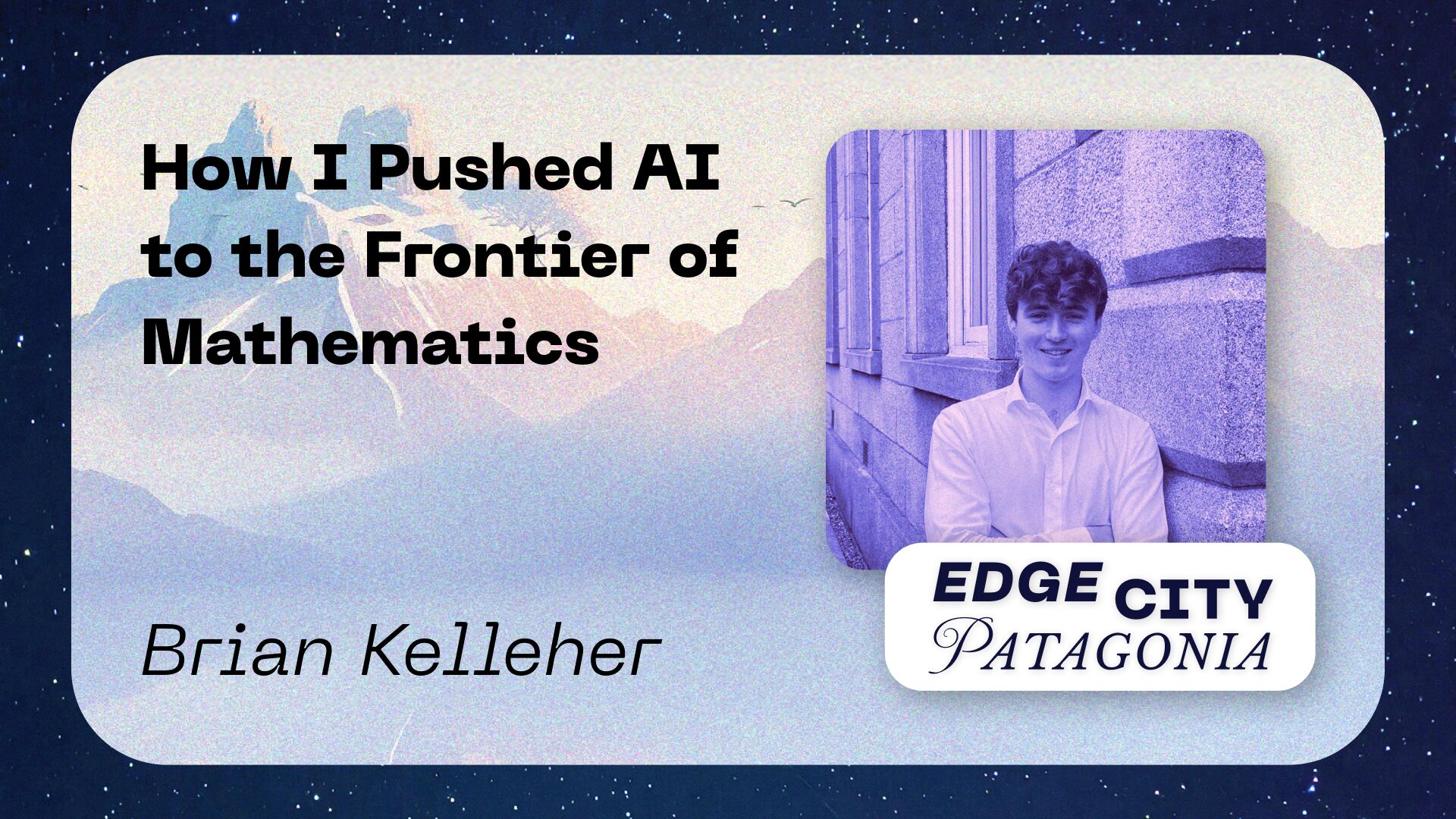
Brian Kelleher — Proving the Unproven
Applied AI and Computational Mathematics
Brian arrived with a bold question: Can frontier Large Language Models (LLMs) meaningfully contribute to frontier mathematics? He built a four-stage AI pipeline to tackle the Erdős problems—a famous set of open mathematical conjectures.
By the end of the month, Brian’s system had identified a tractable problem (Erdős #1) and produced a provisional solution claiming an unconditional linear lower bound.
From Brian: “My system analyzed hundreds of problems before selecting the one it thought was most tractable. After that, the system worked autonomously for days, proving, reviewing, and iterating... In the end, the system produced an approach which the system believes would resolve Erdős's problem 1.”
What’s next: Brian is working with external mathematicians at Oxford university to peer-review the proof and plans to open-source his "CI for Math Research" framework.
Read Brian’s recap essay here →
Connect with Brian on Linkedin and X.
Reflections: Why This Works
This is the fourth cohort of the Edge City Fellowship. We continue to refine our understanding of how high-agency builders thrive. We see immense value in these immersive experiences and plan to scale this model to support larger groups in the future.
This cohort taught us three specific lessons about the physics of building in a village:
- Proximity forces truth. Maxwell arrived with a technically sound plan for sign language translation. The reality on the ground immediately challenged his assumptions. Being physically present with the community forced him to drop his original idea and solve the actual problem of hearing aid calibration. You cannot see the real problem from a distance. You have to be there to let reality break your plan.
- Community regulates ambition. Founders often treat rest as a distraction or a solitary task. In the village, recovery became a shared discipline. Akshaya came to Patagonia recovering from burnout. She found that the collective rhythm of the village—shared meals, hikes, and honest debriefs—acted as a guardrail. This social regulation allowed her to maintain high output without the crash.
- Outsiders unlock new logic. We often silo expertise. Here, a mathematician working on abstract theorems sat next to a researcher mapping cultural data. Brian applied his logic to Rhea’s backend scraping challenges. Rucha merged biology with the concepts of a quantum physicist. The best breakthroughs came when fellows borrowed the mental models of a completely different discipline to solve their own blocks.
As we wrap up this chapter in Patagonia, we are proud of this group. They shipped code and wrote proofs. They also brought kindness and curiosity to the village every day.
A Special Thanks
Finally, we owe a deep debt of gratitude to Sofia Scarlat. As the Fellowship Lead, she architected this experience. She curated this specific group of minds and held the space for their growth.
From facilitating the nightly debriefs to providing daily support, Sofia provided the structure and care that allowed these relationships to flourish. Her leadership turned a collection of individuals into a tightly woven group.
What’s Next?
The Edge City journey continues. We are already looking toward our next gathering. If you are a builder, researcher, or artist looking for a community that challenges you to work at the frontier, we’d love to see you at Edge Esmeralda 2026.